DAG wiring
The pipeline DAG you see in Configure mode isn't drawn by hand. The orchestrator derives it from what's in the RiaH files, with a small amount of OMOP-aware enrichment on top. This page is about how it infers those edges and why you can trust the result.
What the engine actually needs
Most multi-RiaH pipelines share state between steps. The engine has exactly two cross-step state mechanisms:
StoreSequence(<name>)— write a named global sequence value to disk. Subsequent steps continue from there viaAutoGenId(<name>). Used when two RiaHs both append rows to the same CDM table (e.g.claimsandconditionsboth writing intocondition_occurrence— they sharecondition_occurrence_id_seq).StoreIndexMap(<source_key…> → <cdm_key…>)— write a per-key lookup file. Subsequent steps read it viaGetCDMTableId(@<table>, …)to resolve a source-side reference into the CDM ID an earlier step assigned.
Together, those two are how the engine's worker threads stay parallel-safe across steps: writes are local to one step, reads are materialized as files between steps.
How the orchestrator parses this
On every RiaH upload, the orchestrator parses the file and records:
- Produces — the names of every
StoreSequenceandStoreIndexMaprule the RiaH declares. - Consumes — every
GetCDMTableId(@X, …)andAutoGenId(<name>)that references a name some other step produces.
These are stored against the step's RiaH version, so updating a RiaH re-derives the edges immediately.
How the edges get drawn
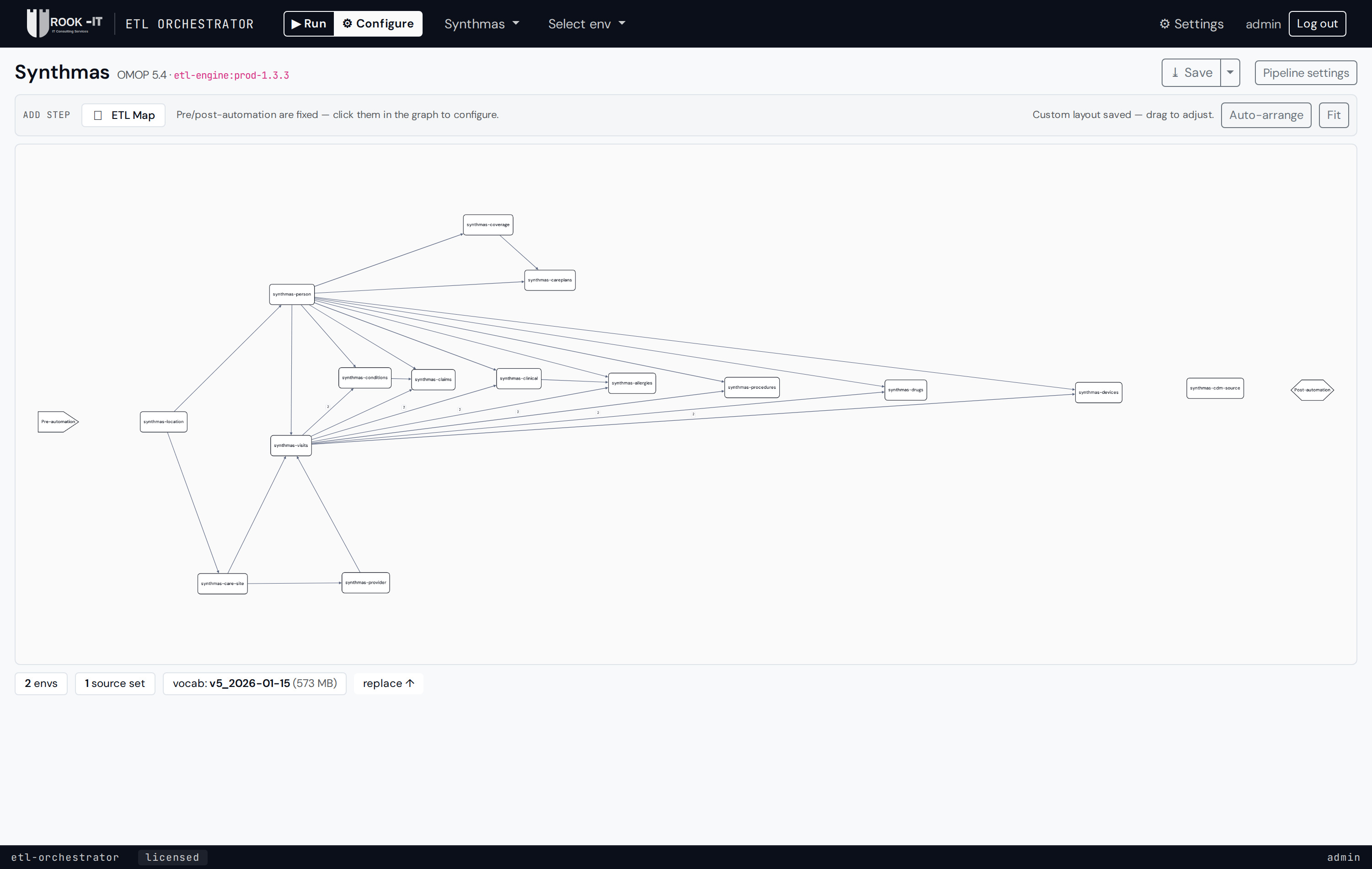
For each pair of steps A, B:
- If A produces
Xand B consumesX→ solid edge A → B, labeled with the artifact name. That's the artifact wiring layer. - If A and B both write into CDM table
T(per their expected-tables lists) → they're declared related (no edge — they collaborate via shared StoreSequence — but they share a cascade, see Cascade).
The orchestrator additionally surfaces:
- FK dependencies between the tables A writes and tables B writes, derived from the OMOP CDM schema for the pipeline's version. These render as dashed edges in the configure DAG — they're informational ("B references rows A creates via foreign key"), not execution-gating.
What you don't need to specify
- Step order. The dispatcher topo-sorts the DAG before each run.
- Edge directions. They come straight from "X is produced here, consumed there."
- Shared-table coordination. The auto-detected shared-writer relationship is what powers cascade re-runs.
If two of your steps SHOULD share state but the orchestrator hasn't
drawn an edge, the RiaH side of the wiring is the place to look —
chances are the producer is using an unnamed StoreSequence or the
consumer's GetCDMTableId is referencing a literal table instead of
@<storedIndexName>.
What the orchestrator does NOT auto-infer
- External data dependencies. If your step's mapping refers to a Usagi or CSVMap file, those aren't artifact-wiring inputs from another step — they're per-step lookup files you upload alongside the RiaH.
- Vocabulary. Vocab is pipeline-scoped, loaded once per env by pre-automation. There's no per-step "I depend on the vocab" edge — every step does, implicitly.