Synthmas — the person table
The person table is the most central table in the OMOP CDM —
practically every clinical event references it via person_id. We'll
map Synthmas's patients.csv into it, and along the way introduce:
- vocabulary lookups via
Mapwith a default plus anAssertNoton the default, - date deconstruction with
YearFromDate/MonthFromDate/DayFromDate, - ID generation with
AutoGenId(recap fromlocation), - and a cross-table lookup with
GetCDMTableId.
Field overview
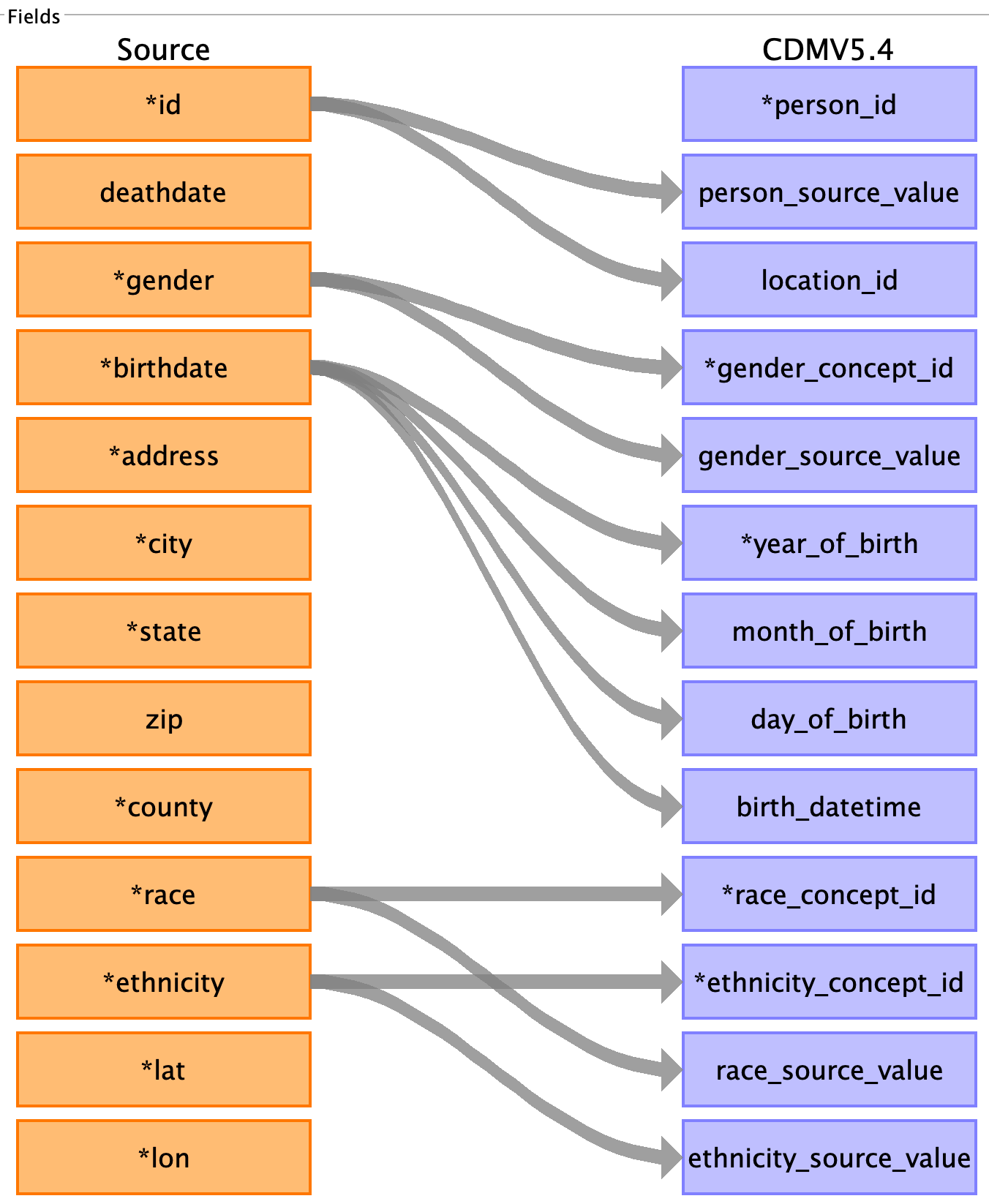
The figure shows the field-to-field arrows for the person table.
A few fields are not in the figure for space reasons (the various
*_source_concept_id columns and provider_id/care_site_id); none
are mapped in this walkthrough — Synthmas's gender, race, and
ethnicity values are all strings, not concept ids, so the
*_source_concept_id slots stay null.
Vocabulary lookups: Map + default + AssertNot
Three fields need vocabulary lookups:
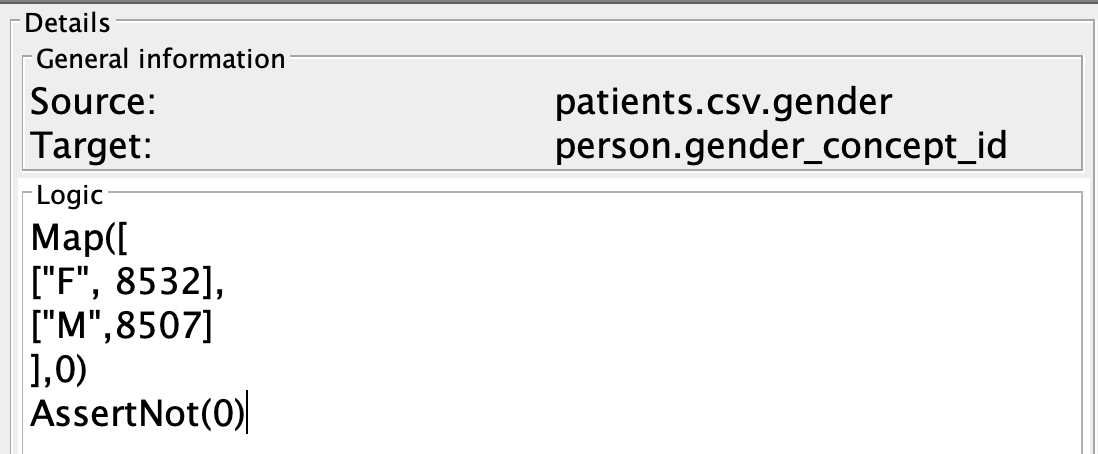
- gender —
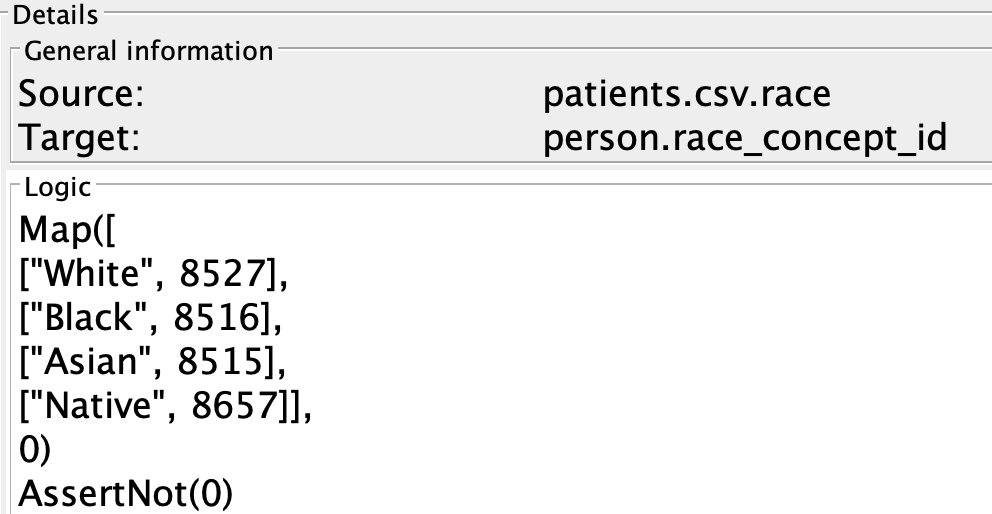
M/F→gender_concept_id. - race —
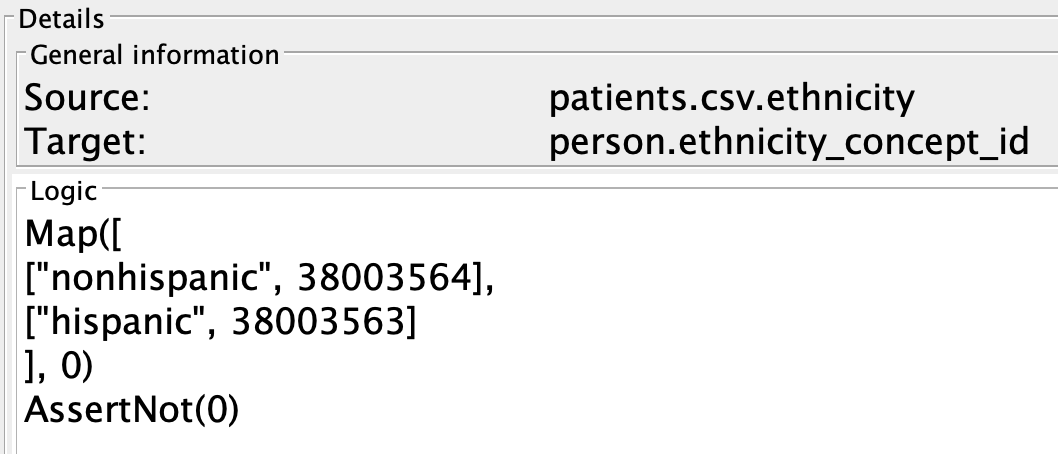
white/black/asian/native→race_concept_id. - ethnicity —
nonhispanic/hispanic→ethnicity_concept_id.
The pattern is the same for all three. Use a
Map with a default value,
then chain an
AssertNot that fails
the row when the default has been used. This way:
- Values you expected get mapped to the right concept id.
- Values you didn't expect end up with the default, fail the assert,
and get logged — so you know to add them to the
Map.
Gender:
Race:
Ethnicity:
For each of the three sources, there is also a parallel arrow to the
matching *_source_value field with no rule — that preserves the
original string so it survives into the CDM.
Why default + assert, not just Map(...)
Without a default, Map does not raise an error on an unmapped
input — it passes the original value through unchanged and sets
successfulMapping = false.
Inside a || chain that's the cue for the next conditional rule to
fire. Outside a || chain it's a footgun: an unmapped STRING like
"unknown" flows on into a CDM INT field, which either errors at
the load boundary or — depending on the driver's strictness —
inserts garbage. Big KA-BOOM.
Default + AssertNot(default) short-circuits both failure modes:
- The default sentinel (here,
0) is a value of the correct type, so type checks pass. AssertNotrejects exactly that sentinel and logs the row, so unmapped values land in the table log instead of the CDM table.
Use this pattern any time Map is the last rule in a chain.
Date deconstruction
Synthmas has birthdate as a date, but the CDM person table wants
it split into year_of_birth (mandatory), month_of_birth,
day_of_birth, and birth_datetime (the original date).
birth_datetime is a straight field-to-field arrow with no rule —
both sides are dates.
The other three need
YearFromDate,
MonthFromDate,
and DayFromDate:
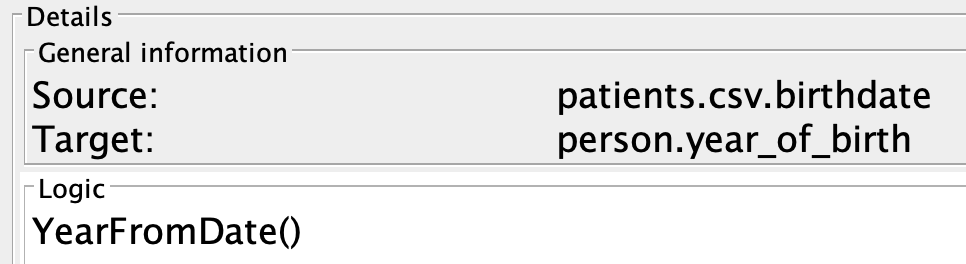
Each rule sits on its own field-to-field arrow from birthdate to
the matching CDM field. They take no parameters.
person_id and location_id
person_id follows the same pattern as
location_id:
- Map the UUID
idfrompatients.csvtoperson_source_value(string-to-string, no rule). - Add an
AutoGenIdon the CDMperson_idfield.
location_id is more interesting. The CDM person.location_id is a
foreign key into the CDM location table — and the location table
was populated with new AutoGenId-issued integers, not the source
UUIDs. The source UUID was preserved in location_source_value.
So to set person.location_id, we look up in location by
location_source_value and return the matching location_id. That's
exactly what
GetCDMTableId
does — and it defaults to using <table>_source_value as the lookup
key and <table>_id as the value, which is the convention we
followed:
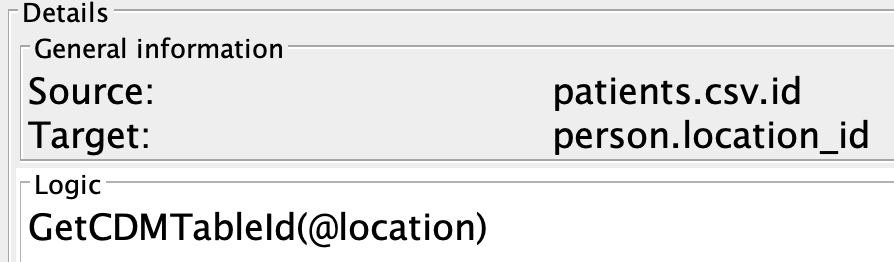
The arrow is patients.csv:id → person.location_id, with the
rule:
Because the rule references the CDM location table, the engine
records an implicit dependency: person cannot be transformed until
location has finished loading.
Recap
The person table now has:
Map(...) + AssertNot(0)for each ofgender_concept_id,race_concept_id, andethnicity_concept_id, with the unmapped rows logged and skipped,*_source_valuefield-to-field arrows that preserve the original string,birth_datetimeas a direct field-to-field arrow,YearFromDate/MonthFromDate/DayFromDateon the three integer date components,AutoGenIdonperson_id, with the UUID preserved inperson_source_value,GetCDMTableId(@location)onlocation_id, which also expresses the load-order dependency.
Next: Useful patterns — vocabulary lookups against the OMOP standard vocabulary, Usagi maps, and conditional chaining.